


 The 16th edition of the Business Excellence Convention-held in Hyderabad from December 16 to 18-was memorable for more reasons than one, not least an eclectic gathering of invitee speakers and a remarkable joint 'interview' with Tata Sons Chairman Ratan Tata and Tata Sons Deputy Chairman Cyrus Mistry by Prasad Menon, chairman, Tata Quality Management Services.
The convention had top leaders and business excellence managers from across the Tata group in attendance, as well as select invitees from a wide spread of other fields. It featured, most prominently, discussions and presentations about business excellence and the Tata Business Excellence Model (TBEM). An important component of this meeting of minds was the recognition, celebration and acknowledgement of the assessor community for the critical role it has played in making the TBEM movement the tremendous transformational methodology it is.
Speaking about the model and the challenges it faces at this juncture of its evolution, Mr Menon said, "We are perhaps at the crossroads of the TBEM movement." The questions he posed-such as: can TBEM be equally valid for mature companies and for companies in the early stages of adapting the model?-made for pertinent reflection. Mr Menon also spoke of creating a truly world-class assessment process and touched upon what could be done to eliminate the score centricity that had crept into the model.
Sunil Sinha, chief, Group Quality Management Services, outlined the milestones achieved by TBEM and the key initiatives that are underway to strengthen the assessment process. A few points were then shared on how the assessment process was going to be different from what had preceded it. These included pointers on tweaking the process, defining the desired profile of assessors, recasting the training procedure with a refreshed outlook, retaining high quality assessors and raising the bar for assessments.
One of the invitee speakers, Stephen Roach, the chairman of Morgan Stanley Asia, talked about the current global business environment and the frequent bouts of turbulence buffeting it. He also spoke about the need for India to ensure that its reforms process does not suffer, to create internal demand for goods and services, to focus on infrastructure development and to do all it can to minimise the divide between the country's rich and poor.
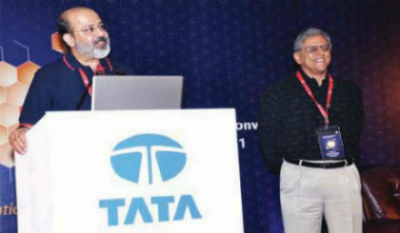
The convention witnessed panel discussions on excellence, commitment and execution. Among the panellists were Dr E Sreedharan of Konkan Railway and Delhi Metro fame, renowned cardiac surgeon Dr Devi Shetty and master chef Ananda Solomon. They spoke about leadership role-modelling and how leaders need to paint a compelling picture with passion and rigour to achieve business excellence.
A panel discussion on innovation, featuring Tata Sons director R Gopalakrishnan, Marico chairman Harsh Mariwala and Prof Clayton Christensen of Harvard Business School, delved into the dimensions of innovation opportunity and how it leads to improved motivation and morale in enterprises and institutions.
The convention also featured a panel discussion on corporate governance, with panellists Nawshir Mirza from Tata Power, Dr Armin Bruck from Siemens and social activist Dr Jayaprakash Narayan. They discussed the need to move from a rules-based system to a values-based culture and described compliance as a growth enabler.
Futurist Rohit Talwar made an enlightening and entertaining presentation on future concerns and trends-global warming and environmental pressures, increasing population and ageing societies, economic power shifting eastwards, advanced materials and the virtual world. He also shared insights on how business organisations can 'future-proof' themselves and work concurrently on the diverse challenges that spring forth from 'what-happens-next' scenarios.
Mark Inglis, renowned mountaineer and motivational speaker, spoke from his experience of being a double amputee who scaled Mount Everest, urging the gathering "to take that first step" in realising goals and objectives that may seem to be insurmountable at first sight. He added that no commitment equals failure and that passion leads to execution and excellence.
Ajay Kumar, vice president for communications at Tata Sons, presented a progress update on the affirmative action activities of Tata companies in India. Also on the convention's menu was a discussion on what it takes to win the coveted JRD QV Award, and the leadership and commitment this demands. The convention drew to a close with a keynote session addressed by MindTree's Subroto Bagchi. He spoke, most tellingly, about the difference between becoming 'successful in life' and 'making a success of life'.
The high-note ending of the convention had Mr Menon posing questions to Mr Tata and Mr Mistry. Their replies-and the responses these elicited from those gathered-were the icing on a sumptuous celebration of all that is best about the group and its continuing quest to scale the peaks of business excellence.