


Tata Consulting Engineers (TCE), a global engineering and consulting firm, is steadily strengthening its data and digital capabilities to support its work across diverse industry sectors including power, infrastructure, hydrocarbons, mining and advanced facilities worldwide. As project complexity increases and client expectations continue to evolve, data is no longer viewed as a support function but as a strategic enabler of engineering excellence, delivery certainty and long-term asset performance.
.jpg)
Over the years, TCE has built a strong reputation for delivering projects that meet high standards of quality, cost effectiveness and schedule discipline. Today, this reputation is being further reinforced through a deliberate shift towards data driven decision making across the organisation. By embedding digital and AI enabled practices into core engineering and project management workflows, TCE is improving predictability, enhancing risk visibility and ensuring that decisions are guided by reliable insights rather than intuition alone.
Building Organisational Capability Around Data
The move towards a data driven enterprise requires more than technology investments. It depends on people understanding how to use data meaningfully in their daily work, supported by clear ownership, governance and execution discipline. Recognising this, TCE reimagined its Data Excellence Practitioners Programme as a focused capability building intervention aimed at translating data strategy into practical execution on live projects.
The pilot of the reimagined Data Excellence Practitioners Programme was conducted from 16 to 18 February 2026. The three-day programme brought together 14 participants representing multiple functions and domains across the organisation. The intent was not to create data specialists, but to enable practising engineers and managers to apply data principles confidently and consistently within their areas of responsibility.
A Programme Rooted in Execution
A defining feature of the reimagined programme was its strong emphasis on application rather than theory. Every concept was directly linked to TCE’s operating context, including engineering workflows, project delivery models and client engagement practices. The programme moved away from abstract dashboards or generic analytics examples and instead focused on real problems that teams encounter during project execution.
Participants explored the fundamentals of data driven decision making, starting with identifying high value data that genuinely influences outcomes. Significant attention was given to clarifying data ownership, defining decision rights and establishing governance mechanisms aligned with TCE’s operating model. This helped participants understand not only what data is important, but also who is accountable for its quality and use.
Another key focus area was integrating analytics and AI into daily work practices. Rather than treating analytics as an after the fact reporting activity, the programme encouraged a shift towards proactive, insight led interventions. Participants examined how early signals from data can be used to anticipate risks, reduce rework, improve coordination and enhance schedule reliability across engineering and project interfaces.
Cross Functional Projects as Proof Points
A key outcome of the programme was the development of cross functional Data Excellence projects. Teams worked collaboratively to define 90-day execution plans focused on specific and measurable improvements within their functions. These plans were designed to be practical, limited in scope and achievable within existing operational constraints.
Each project addressed a clearly articulated business problem and identified the data, governance and behavioural changes required to deliver results. These initiatives are now serving as early proof points for how structured ownership, simplified processes and improved data quality can accelerate decision making and strengthen collaboration across teams.
Early Impact and Organisational Signals
The outcomes from the pilot programme have provided valuable insights for the next phase of TCE’s data journey. Participants responded strongly to the execution first design of the programme, finding greater value in hands on problem solving than in theoretical discussions. This practical orientation helped build confidence in applying data principles directly to ongoing work.
A shared language around data has begun to emerge, improving cross functional alignment and reducing friction between engineering disciplines and support functions. The structured 90-day execution cycles have also reinforced accountability and momentum, enabling teams to see tangible progress within a defined timeframe rather than treating data initiatives as long term or abstract efforts.
Voices from the Participants
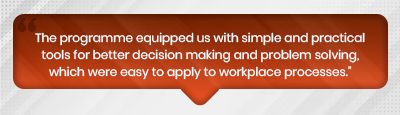
Participant feedback highlighted the relevance and practical value of the programme. Many expressed a strong intent to apply the learnings within their teams and projects.


Looking Ahead
The reimagined Data Excellence Practitioners Programme marks an important step in TCE’s journey towards becoming a mature data driven organisation. By focusing on people, execution and real business outcomes, TCE is ensuring that data and digital capabilities are not isolated initiatives but integral to how engineering work is planned, executed and reviewed.
As these practices scale across the organisation, they are expected to further strengthen project performance, enhance client confidence and support TCE’s long term strategy of delivering engineering solutions that are precise, reliable and future ready.